6 de janeiro de 2017

Imputabilidad: Los jóvenes y la violencia, Silvia Bacher

Muy actual!!


SILVIA BACHER
PARA LA NACION

Jueves 03 de marzo de 2011 

En un mundo de escuchas en el que WikiLeaks deja en evidencia secretos que se creían bien guardados, donde se hacen públicas conversaciones reservadas mantenidas entre políticos, empresarios y sindicalistas, donde los discursos de los poderosos se amplifican; en ese escenario, las voces de los jóvenes siguen sin tener espacio. Miles de niñas, niños y jóvenes en zonas urbanas y rurales se deslizan como sombras sofocadas, como elementos de un decorado que los absorbió al punto de volverlos invisibles.
En los últimos tiempos, a partir de hechos de violencia protagonizados por jóvenes menores de 16 años, parte de la ciudadanía reclama bajar la edad de imputabilidad. Las declaraciones están atravesadas a veces por el dolor y otras, por la liviandad; y, en general, por la falta de herramientas para hacer lecturas más complejas.
Las voces que impulsan reclamos vinculados con la inseguridad apelando exclusivamente al encierro de seres humanos a los que la sociedad les ha negado educación, alimento, salud, respeto y modelos dejan al descubierto un costado mezquino de la humanidad. Un juez de la provincia de Buenos Aires me señalaba que un instituto donde habitan jóvenes en conflicto con la ley es un espacio en el que cada joven puede llegar a estar encerrado en su celda sólo, sin estímulos, hasta 20 horas diarias, y que recibe un promedio de dos horas semanales de educación. ¿Es acaso el encierro una respuesta al problema de todos?
Pero si hablamos de bajar la edad de imputabilidad, ¿es posible considerar que esta medida está actualmente en vigencia, de hecho, sin legislación que la enmarque, por ejemplo cuando un niño nace y crece sometido a condiciones sin resguardo de derechos? Tal vez, el castigo es aplicado desde antes de nacer y el verdugo social es la indiferencia. ¿Es posible proponer entonces que, de adoptarse la norma, se computen estos primeros diez, doce, catorce años como parte de la condena cuando se juzgue a estos sujetos de derecho que no fueron vistos, cuidados y educados por una sociedad que eligió mirar para otro lado?
Un legislador reclamaba semanas atrás, durante el receso legislativo, la urgencia de convocar a sesiones extraordinarias para tratar la baja en la edad de imputabilidad, y afirmaba estar dispuesto a poner el hombro en la emergencia. ¿Acaso no hubo días, meses, años, décadas para legislar e implementar medidas que garantizaran entornos protectores para la infancia y la juventud antes de que su destrato se convirtiera en emergencia?
Un informe producido por el Sistema de Información de Tendencias Educativas en América Latina (Siteal), programa que desarrollan en forma conjunta la Organización de Estados Iberoamericanos para la Educación, la Ciencia y la Cultura (OEI) y el IIPE Unesco, sostiene que los horizontes juveniles en contextos precarios están caracterizados por la inestabilidad y la contingencia. Es allí donde la violencia deviene estrategia para la supervivencia. Sugiere que "la violencia que protagonizan los jóvenes ya como víctimas, ya como victimarios, debe ser calibrada en el contexto de los proyectos sociopolíticos y los modelos económicos contemporáneos". Es una falacia pensarla como brotes que irrumpen en escenarios armoniosos -dice-, sino que debe ser comprendida como parte intrínseca del contexto social. Y advierte que "no es el pensamiento normativo, el pánico institucional, la epidemiología (que considera la violencia un virus aislable), la que permitirá enfrentar la expansión, normalización y «rutinización» de la violencia como sistema de acción en los mundos juveniles".
Pensar la violencia -y en particular en la que los jóvenes son víctimas o victimarios- como hechos aislados no nos permite aproximarnos a comprender las causas (y en consecuencia, las soluciones). Lo urgente no es bajar la edad de imputabilidad y considerar que allí está resuelto el problema, cuando sólo se lo potencia, al ingresar a los jóvenes a nuevas escuelas de delito y a horizontes con mayor desazón y sinsentido. Lo importante, como sostiene el informe del Siteal, reside en pensar qué hechos restituye la violencia, qué compensa, qué metaforiza, qué se oculta en su creciente espectacularización y estruendo.
Reproducir circuitos en los cuales la violencia engendra más violencia no es un camino que conduzca a la paz. Es necesario revertir la precariedad estructural en la que nacen y se desarrollan gran parte de nuestras infancias y juventudes, y fortalecer las políticas sociales que los involucran. La asignación universal por hijo es un paso superador. Pero es sólo un paso de un largo camino que no admite soluciones lineales y que la sociedad argentina debería empezar a recorrer.
© La Nacion
La autora es periodista especializada en Educación. Escribió Tatuados por los medios

Sociólogos dicen que bajar la edad penal mínima en Brasil no reducirá violencia ( y en la Argentina tampoco!)


  • EFE 31-03-2010  ( continúa vigente!)
  • ,
El sociólogo argentino Julio Jacobo Waiselfisz afirmó hoy que la reducción de la edad penal mínima en Brasil no contribuirá para disminuir la violencia en el país suramericano, como proponen líderes políticos y la mayoría de la población.
"Si se baja la edad penal a 16, 15 años, los criminales reclutarán niños de 14 y 13. La solución no es reducir la mayoridad (la edad en la que una persona puede ser procesada) y sí el beneficio que la sociedad da a los jóvenes sin importar la edad", comentó Waiselfisz en diálogo con Efe.
El presidente del Instituto Sangari presentó hoy en Sao Paulo el estudio "Mapa de la violencia 2010: anatomía de los homicidios en Brasil", en el que la tasa de homicidios en Brasil registró una ligera reducción en los últimos diez años, pero la violencia se trasladó de las grandes ciudades a los municipios de interior.
Según el informe, la tasa de homicidios en Brasil bajó desde 25,4 por cada 100.000 habitantes en 1997 hasta 25,2 por 100.000 habitantes en 2007.
En números absolutos, Brasil registró cerca de 47.700 homicidios en 2007, con un promedio de 117 muertes por día, según estadísticas del Ministerio de Salud citadas en el informe.
El educador argentino Jorge Werthein, vicepresidente de Sangari Brasil, lamentó el impacto de la violencia en la población negra.
"Es alarmante el reflejo en los homicidios de la discriminación racial, pues es la población (negra) la que más demora en ser alcanzada por los programas sociales", indicó a Efe el especialista argentino.
Mientras que en 2002 morían 1,7 negros de entre 15 y 24 años por cada joven blanco con la misma edad muerto, esa proporción pasó para 2,6 negros por cada blanco en 2007.
Werthein consideró que "sólo con represión no se reduce la violencia. Es un conjunto de acciones, inteligencia y represión calificada lo que permite una estrategia preventiva para garantizar políticas de inclusión social para la juventud, que es el foco más vulnerable de la violencia en Brasil".

5 de janeiro de 2017

South Africa has one of the world’s worst education systems


Why it is bottom of the class

AFTER half an hour of pencil-chewing Lizeka Rantsan’s class lines up at her desk to hand in its maths tests. The teacher at Oranjekloof primary school in Cape Town thanks the 11- and 12-year-olds and flicks through the papers. Ms Rantsan sighs, unimpressed. Pulling one sheet of errant scribbles from the pile she asks: “How are we supposed to help these children?”
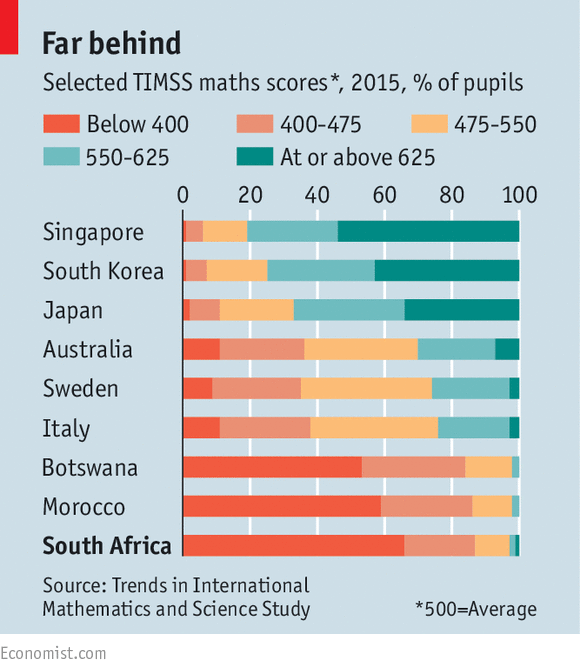
It is a question that South Africa is failing to answer. In a league table of education systems drawn up in 2015 by the OECD club of mainly rich countries, South Africa ranks 75th out of 76. In November the latest Trends in International Mathematics and Science Study (TIMSS), a quadrennial test sat by 580,000 pupils in 57 countries, had South Africa at or near the bottom of its various rankings (see chart), though its scores had improved since 2011. Its children are behind those in poorer parts of the continent. A shocking 27% of pupils who have attended school for six years cannot read, compared with 4% in Tanzania and 19% in Zimbabwe. After five years of school about half cannot work out that 24 divided by three is eight. Only 37% of children starting school go on to pass the matriculation exam; just 4% earn a degree.

South Africa has the most unequal school system in the world, says Nic Spaull of the University of Stellenbosch. The gap in test scores between the top 20% of schools and the rest is wider than in almost every other country. Of 200 black pupils who start school just one can expect to do well enough to study engineering. Ten white kids can expect the same result.
Many of the problems have their roots in apartheid. The Bantu Education Act of 1953 set out to ensure that whites received a better education than blacks, who were, according to Hendrik Verwoerd, the future prime minister then in charge of education, to be educated only enough to be “hewers of wood and drawers of water”. Black pupils received about a fifth of the funding of white peers. They were taught almost no maths or science. Most independent church-run schools that provided a good education in black areas were shut.
After Nelson Mandela became president in 1994 his government expanded access to schooling. It also replaced a school system segregated by race with one divided by wealth. Schools in poorer areas receive more state funding. But schools in richer areas can charge fees on top.
In theory these schools must admit pupils even if their parents cannot afford the fees. In practice they are fortresses of privilege. There are still about 500 schools built from mud, mainly in the Eastern Cape. The Western Cape has some of the largest campuses in the southern hemisphere, with cricket pitches as smooth as croquet lawns.
And yet money is not the reason for the malaise. Few countries spend as much to so little effect. In South Africa public spending on education is 6.4% of GDP; the average share in EU countries is 4.8%. More important than money are a lack of accountability and the abysmal quality of most teachers. Central to both failures is the South African Democratic Teachers Union (SADTU), which is allied to the ruling African National Congress (ANC).
The role of SADTU was laid bare in a report published in May 2016 by a team led by John Volmink, an academic. It found “widespread” corruption and abuse. This included teachers paying union officials for plum jobs, and female teachers being told they would be given jobs only in exchange for sex. The government has done little in response. Perhaps this is unsurprising; all six of the senior civil servants running education are SADTU members.
The union’s influence within government belies its claim that officials are to blame for woeful schools. Last year it successfully lobbied for the cancellation of standardised tests. It has ensured that inspectors must give schools a year’s notice before showing up (less than 24 hours is the norm in England). And although parent-led school governing bodies are meant to hold teachers to account, they are more often controlled by the union, or in some cases by gangs.
But even if there were better oversight most teachers would struggle to shape up. In one study in 2007 maths teachers of 11- and 12-year-olds sat tests similar to those taken by their class; questions included simple calculations of fractions and ratios. A scandalous 79% of teachers scored below the level expected of the pupils. The average 14-year-old in Singapore and South Korea performs much better.
It does not have to be this way. Spark School Bramley in Johannesburg is a low-cost private school, spending roughly as much per pupil as the average state school. And it is everything state schools are not. Its 360 pupils begin learning at 7.30am and end around 3pm-4pm; most state schools close at 1.30pm. At the start of the day pupils gather for mindfulness exercises, maths questions, pledges to work hard—and a blood-pumping rendition of Katy Perry’s “Firework”. “We have an emotional curriculum as well as an academic one,” says Bailey Thomson, a Spark director.
Pupils attend maths lessons based on Singapore’s curriculum; literacy classes draw on how England teaches phonics. Crucially, teachers are not members of SADTU. But they receive 250 hours of professional development per year, about as much as the average state-school teacher gets in a decade.
Early results show that its pupils are on average a year ahead of their peers. Spark runs eight schools and plans to have 20 by 2019. Other operators, such as Future Nation, co-founded by Sizwe Nxasana, a former banker, are also expanding. “We are never going to have a larger footprint than [the] government but we can influence it,” hopes Stacey Brewer, Spark’s founder.
Another promising scheme is the “collaboration schools” pilot in the Western Cape, based on academies in England and charter schools in America. The five collaboration schools are funded by the state but run by independent operators. In what Helen Zille, the premier of the Western Cape, calls “a seminal moment”, the parents of Oranjekloof pupils petitioned to keep the school in the collaboration programme when unions tried to oppose it. Ms Zille wants to open a “critical mass” of collaboration schools to inject competition into the public system.
Spark and the collaboration schools suggest that South African education need not be doomed. But together they account for a tiny fraction of the country’s more than 25,000 schools. Widespread improvement will require loosening the grip of SADTU. In local polls in August the ruling party saw its worst results since the end of apartheid. This may force it to review vested interests. More likely it will continue to fail children. “The desire to learn has been eroded,” says Angus Duffett, the head of Silikamva High, a collaboration school. “That is the deeper sickness.”

The Iceberg Effect Report


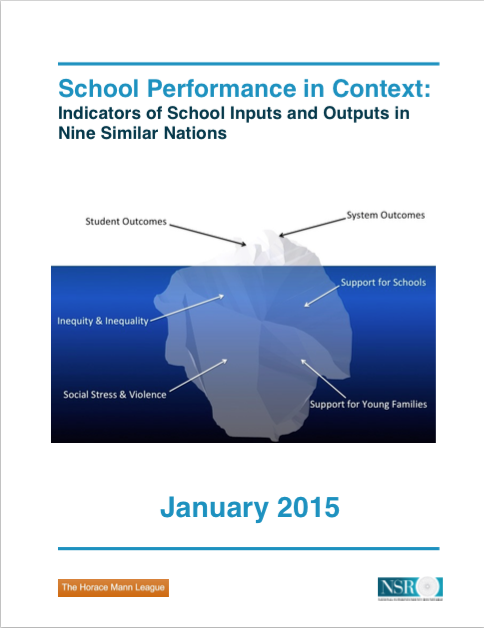
School Performance in Context: Indicators of School Inputs and Outputs in Nine Similar Nations is a joint project of the National Superintendents Roundtable and the Horace Mann League. Click below to download the full report and the summary report for free. Scroll down to purchase the full, four-color report and have it mailed to your door.
This report does what has been missing in international assessments like PISA and TIMSS…It provides a broader context to understand how education systems perform…simply an eye-opening reading experience!
— Palsi Sahlberg, Harvard University, author of Finnish Lessons

 Click to Download:

The Summary Report
The Full Report (with data)

An Introduction to the Report:


To embed the video on your website, use the following code: 

Order a Hard-Copy of the Report:

Glossy, full-color. Max units per order: 10
Choose the price bracket in the drop-down menu to the right. The price listed is the unit price. Once re-directed to Paypal, be sure to manually enter the number of copies you wish to order.
Screen Shot 2015-01-11 at 3.13.52 PM

Bulk Discounts: Price per unit


Fact Sheet on American Schools Today:

How does this report fit into the larger picture of the U.S. school system? Click to download the fact sheet here.

Reviews: What Educators are Saying About School Performance in Context (PDF):


It’s important that America understands what we’re facing as educators. We’re in a nation stricken with poverty and yet we’re not addressing it.
— Laurie Barron, superintendent, Kalispell, Montana

I come from a district with about 86 percent free and reduced lunch. I want to take these findings and educate my community. We need to make sure we’re attacking factors like poverty and social services.
— Leslie Boozer, superintendent, Fontana Unified School District, California

It’s amazing that we’re such a rich country and yet in my Iowa district, 63 percent of our children have financial needs. We’re not doing enough to help them and schools can’t do it all.
— Martha Bruckner, superintendent, Council Bluffs, Iowa

School Performance in Context underlines the irrationality of assigning undue importance to standardized tests. Defining American education by a score on a test disregards the many factors affecting that score, childhood poverty being one of the most significant.
— Dan Domenech, executive director, American Association of School Administrators (AASA)

Globalization means we have to be internationally engaged, economically and culturally. Future-focused leaders will benefit greatly from immersing themselves in the realistic international comparisons contained in this report.
— Joe A. Hairston, co-director, AASA-Howard University Urban Superintendents Academy

The most striking thing from the data—and something that all policymakers should be concerned about—is that here we sit as the wealthiest nation in the world and we have the highest percentage of children in our schools living in poverty.
— Charles Fowler, president, Lead Schools

It’s quite overwhelming to see the statistics on the broader context brought together in this way. It is impressive that American schools do as well as they do in this environment.
— Iris Rotberg, George Washington University; editor, Change and Tradition in Global Education Reform

The information in this report is far more informative than test scores alone. We can learn much from School Performance in Context about meaningful ways to help all children succeed in school.
— Diane Ravitch, New York University; author of Reign of Error

This report does what has been missing in international assessments like PISA and TIMSS…It provides a broader context to understand how education systems perform…simply an eye-opening reading experience!
— Palsi Sahlberg, Harvard University, author of Finnish Lessons

A fascinating report that highlights the importance of context and the…often deeply misleading nature of test scores taken in isolation.
— Alison Wolf, Kings College (London); education advisor, Government of Prime Minister David Cameron

This is a significant piece of work. I think it has real potential for furthering the conversation about where we really are in education in the United States.
— Karen Woodward, superintendent, Lexington Schools, South Carolina

4 de janeiro de 2017

Cuál es la edad mínima de responsabilidad criminal en otros países de la región


Yo concuerdo con UNICEF

Mirá cómo es la ley para menores en otros lugares: cuántos menores privados de la libertad hay en la Argentina y cuál es la postura de Unicef sobre cambios en la legislación

LA NACION
MIÉRCOLES 04 DE ENERO DE 2017 

La baja de la edad de imputabilidad volvió a ponerse en agenda. El Gobierno adelantó que trabajará en una propuesta al respecto. En América Latina, la edad mínima de responsabilidad criminal va desde los 7 años, en Trinidad y Tobago, hasta los 18 en Brasil, según un informe de Unicef.
"En muchos países hay un régimen intermedio de "responsabilidad social" de niños por debajo de la edad de responsabilidad criminal. Bajo esta perspectiva, niños por debajo de la edad mínima de responsabilidad criminal pueden estar sujetos a alguna forma de responsabilidad social, que incluye la posibilidad de sanciones", sostiene el estudio, titulado "Edades legales mínimas y la realización de los derechos de los adolescentes. Un repaso sobre la situación de América Latina y el Caribe".


"En los países en que existe esto, generalmente se aplica para acciones que son consideradas ofensas criminales cuando son cometidas por una persona por encima de la edad de responsabilidad criminal", señala Unicef.

La situación de los menores institucionalizados en Argentina


Según el último relevamiento realizado por Unicef, hay 1305 menores privados de su libertad en centros cerrados.
Casi la totalidad son varones, argentinos, mayoritariamente entre 16 y 17 años.
Al momento del relevamiento, el 6,3% eran niños menores de 16 años.
El 80% de adolescentes privados de su libertad se concentran en 5 jurisdicciones: Buenos Aires, Córdoba, CABA, Mendoza y Santa Fe.

La postura de Unicef

"La normativa a nivel nacional es incompatible con la Convención sobre los Derechos del Niño".
"De acuerdo al Régimen Penal de la Minoridad vigente desde el año 1980, entre los 16 y los 18 años de edad los adolescentes son punibles penalmente y tienen menos garantías procesales que los adultos".
"La ausencia de una ley marco nacional favorece discrepancias entre provincias".
"En el caso de los adolescentes menores de 16 años, aunque la ley vigente establece que no deben ser penados, en algunas jurisdicciones existe la posibilidad de que el juez dicte medidas de privación de su libertad, contraviniendo los estándares internacionales en materia de derechos humanos".
"La escasa implementación de medidas alternativas a la privación de la libertad y de justicia restaurativa, las malas condiciones edilicias de los centros de detención, el bajo grado de especialización del sistema de justicia juvenil así como el incumplimiento de sus derechos cuando están privados de libertad (acceso a una defensa efectiva, conocimiento del proceso penal al que se ven sometidos, acceso a la educación, al esparcimiento y a la salud) son retos que aún perduran en el sistema de justicia".
Unicef propone "la aprobación de una Ley de Justicia Penal Juvenil que no disminuya la edad de imputabilidad, que cree un sistema especializado en línea con los estándares internacionales en materia de protección de derechos humanos, que garantice que cada adolescente sea sometido a un proceso penal con las debidas garantías, en el que se le apliquen -como regla- medidas no privativas de la libertad, dejando como sanción excepcional (solo en casos de extrema necesidad) la restricción de la libertad personal"
"Es clave que una reforma legislativa esté acompañada de una fuerte inversión en políticas públicas de protección integral de la niñez y adolescencia".
"Sería importante que se amplíe y mejore la oferta de medidas alternativas, justicia restaurativa, instancias de mediación y justicia comunitaria".
"Sería un gran avance contar con un sistema de información nacional sobre niños, niñas y adolescentes en conflicto con la ley penal para poder dimensionar el fenómeno y diseñar políticas públicas pertinentes y eficaces para abordar esta problemática".

A Misinformed, Embarrassing Article from Brookings about Our “Failing Schools” by dianeravitch


The Brookings Institution was once known as a reliable source of thoughtful, informed analysis of important policy issues. In the past decade, it has turned its education commentary over to rightwing ideologues, who are driven by ideology and indifferent to facts that they ought to know.

On behalf of Brookings, Jonathan Rockwell, economist for Gallup, complains that the U.S. spends more on education, has seen no improvement in decades, and is seeing no gains in productivity. He ends by saying that low-income families can't afford private tutors or home schooling, as though these were viable ways to improve education for the poorest children .

I can't unpack all this in a short space, but I would like to show you in a few paragraphs why this is an uninformed article. To begin with, Rockwell cherrypicks the data on test scores. This makes his analysis misleading and wrong. Test scores are the highest they have ever been on the only longitudinal measure we have: the National Assessment of Educational Progress (NAEP). He selectively quotes one version of the NAEP, while ignoring the other.

There are actually two versions of NAEP. One is called the "Long Term Trend" (LTT) data, the other is main NAEP. The LTT is offered every four years to samples of students at age 9, 13, and 17. Main NAEP is given every other year to students in grades 4 and 8.

LTT contains questions that are unchanged since the early 1970s and have no relation to what students are taught today. Occasionally, questions are deleted because their content is obsolete (e.g., a question that refers to S&H Green Stamps). The data for 17-year-olds is especially dubious because this group has no incentive to take the NAEP tests seriously.

The National Assessment Governing Board is aware of the problem of low motivation among 17-year-olds. When I served on the board, from 1994-2001, we devoted a large part of one of our quarterly meetings to this problem. There was talk of incentives, pizza parties, cash, but it was not resolved. The bottom line, however, is that any data about the test scores of 17-year-olds must acknowledge that this group doesn't care about the test because they know it doesn't matter. What the board learned when we discussed it is that some 17-year-olds doodle on the answer sheet or answer every question by checking the same letter. They don't care.

I recommend that Rockwell read Chapter 5 of my book Reign of Error. He would learn there that the scores on the main NAEP reached their highest point ever in 2013 (they were flat for the first time in many years in 2015). This was true for every group of whites, blacks, Hispanics, and Asians. He would also learn that the graduation rate was the highest ever for these groups, and the dropout rate was the lowest ever. He would see a different reading of the LTT data, showing a dramatic rise in test scores in math for black students and Hispanic students in all three age groups, and for white students at ages 9 and 13, from 1973 to 2008. Even white 17-year-olds saw a gain, but it was small.

If I may quote my analysis, based on a review of both versions of NAEP, "NAEP data show beyond question that test scores in reading and math have improved for almost every group of students over the past two decades: slowly and steadily in the case of reading, dramatically in the case of mathematics."

I would also urge Rockwell to read chapter 7, which reviews the international test scores. It shows that we were never #1 in test scores on international tests. In fact, when the first international tests were given in 1964, we were last among 12 nations. Yet over the half century that followed, we outpaced all the other 11 nations by every measure.

I know that Brookings uses Google or some other search engine to find anything that quotes its articles and research. I hope that they find this article and bring it to the attention of Jonathan Rockwell.

More important, I can only hope and wish that Brookings would make the effort to employ genuine education researchers to write and declaim about this important subject. Over the past decade, its education spokesman was Grover Whitehurst, George W. Bush's former research director, who turned Brookings into a cheerleading think tank for school choice. This is unworthy of a once-great and once-trusted institution.

Technology Trade-offs in a Physics Classroom (Alice Flarend) by larrycuban


“Alice Flarend is a National Board Certified Teacher and is the physics teacher at Bellwood-Antis High School in Pennsylvania.  She holds a B.S and M.S in Nuclear Engineering from University of Illinois and University of Michigan respectively. Alice caught the teaching bug while doing engineering doctoral work at the University of Michigan and has been teaching for over twenty years.  She is currently working part time on a Science Education Ph.D at Penn State.  She plans on remaining in her classroom to be a bridge between the worlds of higher education  and public K-12 schools.”
One of the first uses of computers in many physics classes decades ago was to graph data using Excel. This innovation prompted lengthy discussions among physics teachers at meetings and conferences about the trade-offs of having students use this aid rather than graphing by hand. Excel could make graphing so easy, but the students could lose the skill of creating axes, legends, and interacting with their data.
I have found these types of discussions distinctly lacking as we move more classroom activities onto the digital world. I want to call attention to the often overlooked trade offs between efficiency and quality of information that occur when classroom tasks are handled electronically. While the examples I present  are from my world of physics teaching, I have seen similar ones in my high school as we have moved through a 1-to-1 iPad initiative.
Physics classes are inherently hands on. We drop marbles and roll balls down inclines, usually with stop watches in our hands. Computer simulations and digital data collection for laboratory experiments are replacing those stop watches. Computers allow students to collect more and cleaner data than ever before. Calculations are done internally and instantly displayed graphically. Patterns are easier to discern. Multiple trials are accomplished with a click.
However, that simple click masks information about the data collection and processing. It hides the messy experimental and mathematical work that is the basis for the patterns. My students believe that any graph on the screen must be an accurate representation of a ball in motion, even the wildly inaccurate ones caused by ball being nowhere near the digital sensor. It is so easy for students to lose sight of the actual physical world as they analyze those pretty digital graphs.
My early experiences with an internet-based homework service were more positive than turning in paper homework. Particularly with difficult problems,  paper homework tends to be more of a “I didn’t understand this but at least I got something to turn in” type of experience. Internet-based homework gives students a particular number of attempts so they keep trying a problem until they get it right. I could give my students challenging work and their grades would not suffer terribly because they could keep working until they got it right. Because my homework service does not have a sophisticated "help" function, students would come to me for aid. They gained a deeper understanding as we talked and I gained valuable formative assessment feedback.
In the last few years, however, there has been a disturbing trend of students searching online for solutions. The problem is these online solutions are not educative solutions. They just give a bare-bones derivation and students then plug in their numbers into the final equation. Students get the problem marked correct but they do not actually understand the solution. With increased use of these online tools, I have more students who take only a single try to get each homework problem correct, but then fail the test.
This automatic grading, a feature of many digital products, saves me time and the students get immediate feedback. They can be used in real time in the classroom. For the most part, these grading programs are limited to multiple choice questions or numerical solutions. As an experienced teacher, I can create these types of questions to probe my students' knowledge, but they are limited to more simple ideas and preprogrammed choices. I prefer open-ended types of questions where the students write a long enough answer so their misconceptions and uncommon ideas can emerge and be explained in unique ways. I can look at their work with mathematical problems. That is where I find the most useful formative assessment. With digital grading programs, I lose a lot of that valuable information.
Tools like Google Classroom are supposed to ease communication between teachers and students. They allow efficient dissemination of classroom materials to students and collecting their work. The perennial excuses of "I lost the handout" or “My printer ran out of ink” are no longer applicable when students can just download another copy or email me their documents. I can easily add comments to those documents submitted to me, helping students to improve their work. All of this can be done at any moment that the student or teacher wishes, at school or at home.
In my experience, I have seen little evidence that this ease of communication has increased the quantity or quality of my students’ work. Students who neglected to turn in paper homework also neglect electronic versions. Students who lose handouts do not download new copies. I can write many helpful comments on students’ work and they will receive a notification that a comment has been posted. Nothing in the program, however, makes the students read these comments and improve their work. Now the same can be said for comments written on paper, but in judging the large numbers of requests I receive for translation of my third-grade handwriting, my students do tend at least to read my handwritten comments.
Overall, this apparent ease of accomplishing classroom work has created a larger gap between the students. Students who work to understand the material and see a purpose in school, do take advantage of the affordances of the technology as they do all other supports.   Many other students disconnected from learning in school are not lured into learning because of screens, despite the promises of the tech literature. They do not take advantage of internet tutorials to increase their understanding. They do not look at my comments and do a rewrite of their rough draft. They do not open up lines of communication outside of classroom time, despite having a device and programs that will do this with only a few clicks. This gap has always existed, but the digital aspect has increased it, or at least made it more visible.
What I have learned from these experiences is to be vigilant in the use of technology. It offers many advantages in making tasks easier and more efficient. It does not, however, easily transform any classroom activity into one where deep learning occurs. In fact, it can easily do the opposite and mask difficulties in a flurry of correct answers and perfect graphs.
larrycuban | January 4, 2017